
Canchuks Corrosion Inc. has developed a high-precision methodology that’s changing how pipeline integrity is assessed, particularly in unpiggable segments. By integrating Contactless Magnetic Inspection Technology (CMIT) into the established Direct Assessment (DA) framework, operators gain direct anomaly confirmation and eliminate up to 60% of unnecessary digs. This hybrid approach brings a step-change in accuracy, efficiency, and cost control.
The Challenge: Conservatism in Direct Assessment (DA) Drives Cost
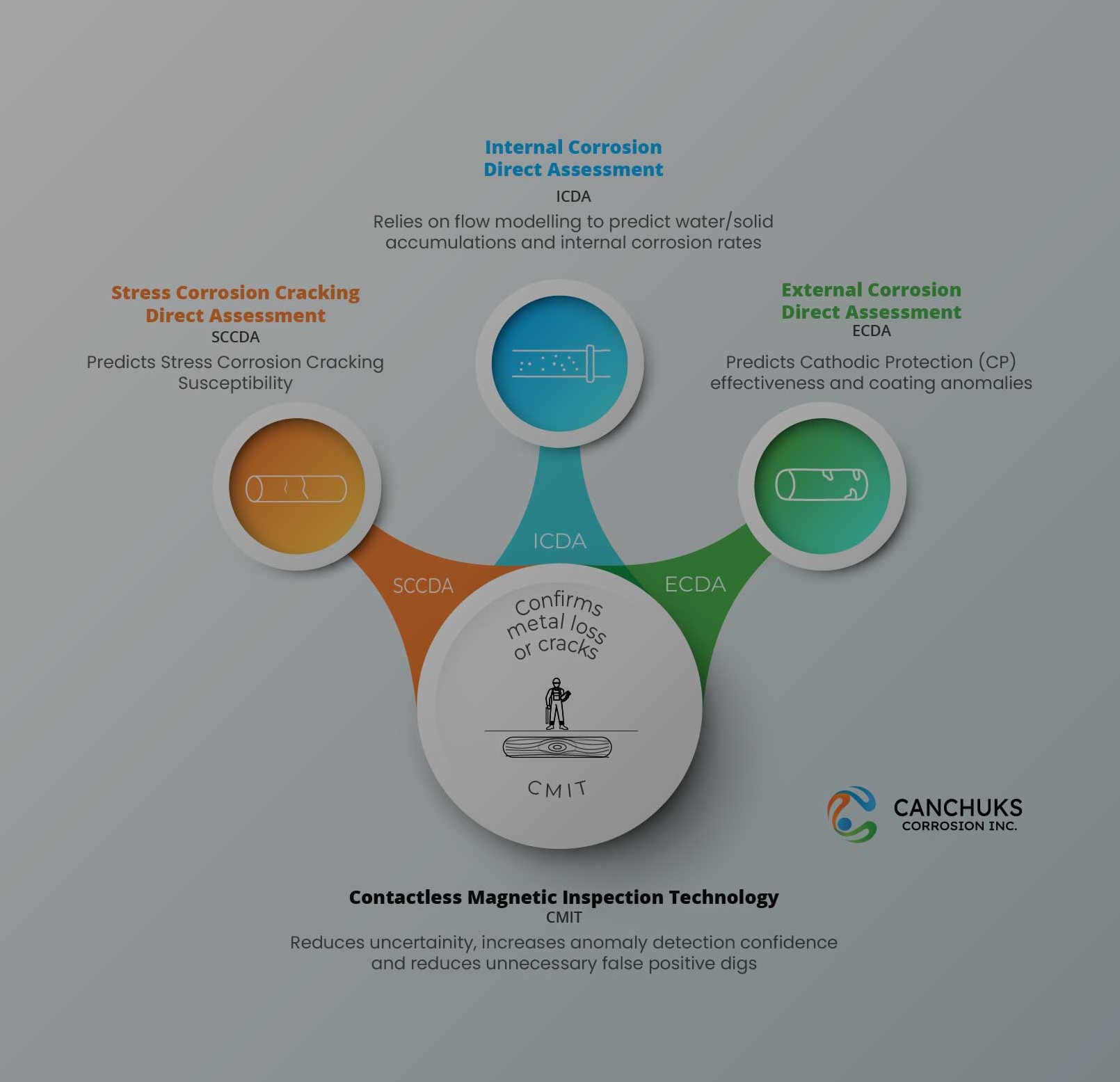
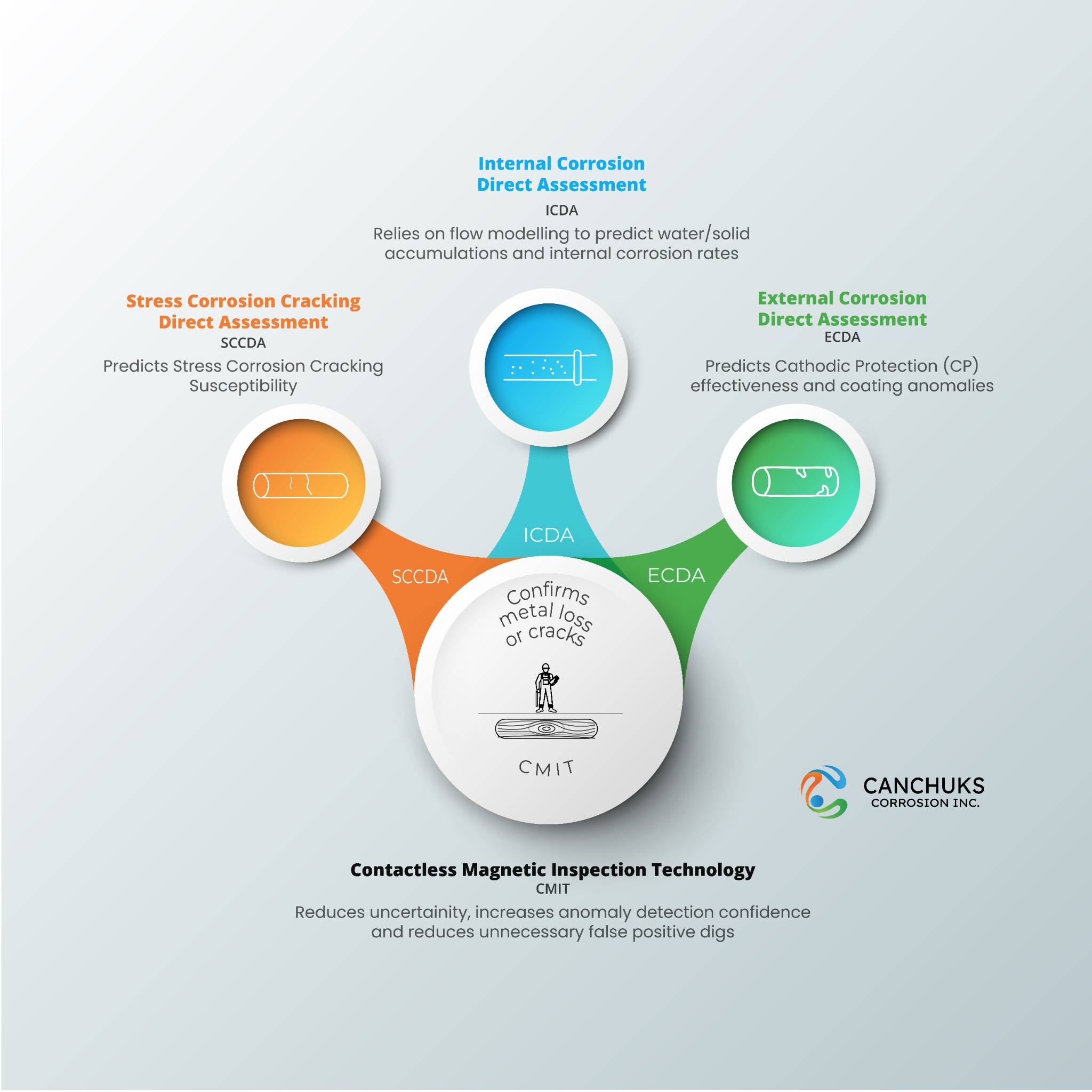
DA methodologies, including External Corrosion Direct Assessment (ECDA), Internal Corrosion Direct Assessment (ICDA), and Stress Corrosion Cracking Direct Assessment (SCCDA), use indirect methods such as signals (like CP measurements), flow modelling, operating conditions, or stress conditions to infer potential threats.
While proven and widely used, these methods are inherently conservative. Operators often excavate based on worst-case assumptions, leading to high inspection costs and low anomaly hit rates.
The Innovation: CMIT + DA for Confirmed, Cost-Efficient Pipeline Integrity
When combined with CMIT, DA methodologies gain a high-fidelity confirmation layer. CMIT directly detects magnetic field disturbances associated with metal loss, crack-like
-
Metal loss
-
Crack-like features
-
Weld irregularities
-
Stress concentrations
By overlaying CMIT onto existing DA workflows, Canchuks Corrosion provides a direct, aboveground confirmation step. Instead of relying on indirect clues, operators gain actionable evidence of real defects.
In a typical integrated CMIT + ECDA workflow:
-
CIPS identifies CP protection adequacy
-
Direct Current Voltage Gradient (DCVG)/ Alternating Current Voltage Gradient (ACVG)/Alternating Current Current Attenuation (ACCA) pinpoint coating degradation or shielding.
-
CMIT confirms whether these indications correspond to actual metal loss, cracks, or stress anomalies.
-
SCCDA assesses cracking susceptibility using historical SCC data, stress conditions, coating characteristics, metallurgical properties, and environmental factors.
This synergy, shown in the figure below, reduces false-positive excavations, improves prioritization accuracy, and enhances the defensibility of integrity decisions:
The Results: Fewer False Positives, Greater ROI
Operators using the integrated CMIT + DA methodology have achieved:
-
Up to 60% reduction in unnecessary digs
-
Improved threat prioritization and defensibility
-
Stronger compliance posture with lower operational disruption
See our CMIT framework in action!
Download the full case study to learn how Canchuks Corrosion helped pipeline operators reduce excavation costs while increasing the precision of their integrity decisions.

 Copyright © 2025 Canchuks Corrosion Inc. Corrosion Experts